The gaming industry has entered a strange era. AAA games have never been bigger. Budgets are higher, graphics are more realistic, and marketing campaigns are larger than ever. Studios are spending hundreds of millions of dollars trying to create the next global gaming phenomenon. Yet, many players are starting to look elsewhere. They are choosing smaller games with unique ideas over blockbuster titles created by some of the biggest companies in the industry. Why?
Because indie games have changed the way players look at gaming. Games like Undertale, Lethal Company, Balatro, Hollow Knight, and Stardew Valley did not become successful because they had massive corporations backing them. They succeeded because somewhere, a small team of developers created something players genuinely wanted. Indie developers are not competing with AAA budgets. They are competing with creativity. And right now, creativity is winning.
The biggest challenge facing AAA gaming today is not failure—it is becoming forgettable.
While many blockbuster games focus on bigger maps, realistic graphics, and familiar formulas, players are increasingly searching for experiences that feel different. Indie games have delivered exactly that: strange ideas, personal stories, experimental gameplay, and mechanics that challenge what games can be. The result?
Small studios are creating some of the most memorable gaming experiences of the decade.
Cross-platform indie hits like Minecraft, Fall Guys, and Rust have built massive communities, attracted millions of viewers, and proven that a game's impact is not determined by its budget.
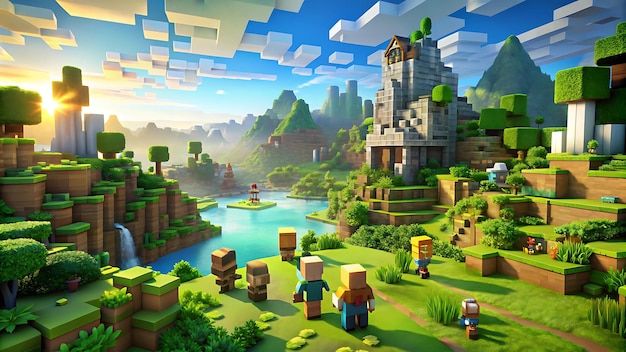
The biggest example is Minecraft.
What started as a simple block-building survival game became a global phenomenon. With its endless creative possibilities, Minecraft has sold over 300 million copies worldwide, making it the best-selling video game of all time and surpassing legendary franchises like Grand Theft Auto and Tetris in total sales.
A game made with simple blocks defeated some of the most expensive productions in gaming history—not because it had the biggest budget, but because it gave players something far more valuable: Creative freedom.
Minecraft wasn't just an indie success story. It was proof that originality can outperform money. A game built from digital blocks became bigger than games built with billion-dollar budgets.
And that's the biggest lesson AAA studios can learn from indie developers. It isn't about budget. It's about confidence.
Small developers are proving that players don't always want the biggest world, the most expensive graphics, or the longest campaign. They want something that feels original.
AAA studios have the resources to create unforgettable experiences. But in an industry where every game is competing for attention, money alone is no longer enough.
Because in 2026, the biggest threat to blockbuster gaming isn't another AAA competitor. It's a small team somewhere, creating something nobody has seen before.